Why an increasing share of Ivy League graduates are playing professional basketball
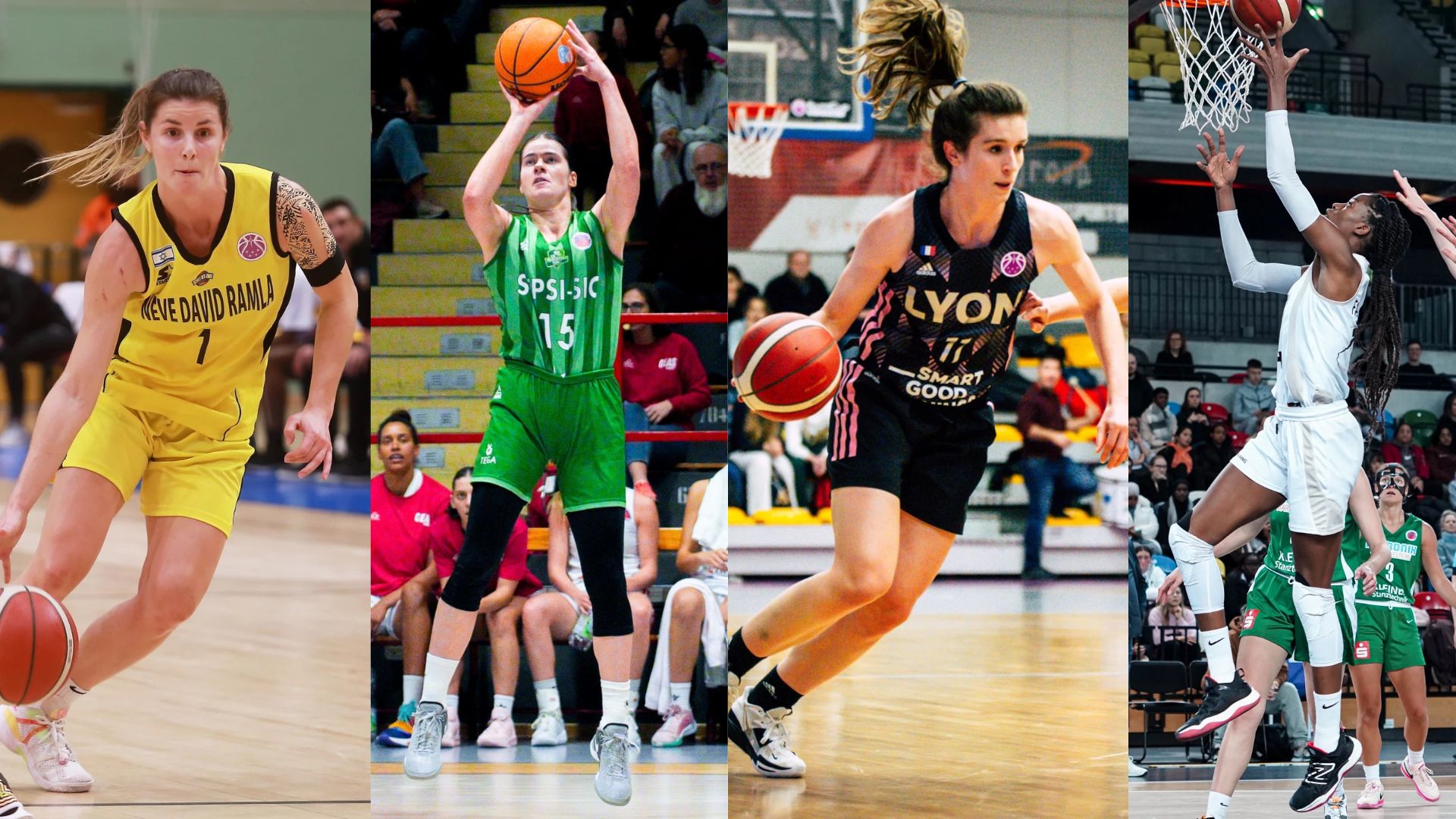
The NCAA estimates that 9% of women’s college basketball players end up playing professional basketball, whether in the United States or overseas. But over the past 16 years, 16% of seniors in Ivy League women’s basketball — 57 players total — have gone on to play professionally.
And that share has been growing in recent years. From 2018 through 2025, 20% of Ivy League seniors went on to play professionally, compared with 11% of seniors who graduated between 2010 and 2017. The Ivy League class of 2025 produced seven pros from five schools; both numbers are tied for the most in the past 16 classes.

The data for this analysis comes primarily from Her Hoop Stats and EuroBasket. For more on how it was conducted, read the section at the end of this article titled “How professional players were counted.”
Since 2010, Ivy League alumnae have played professionally in 36 countries. Spain is the most common, as 13 alumnae have played there. Ten have played in the U.S., eight have played in the United Kingdom, and seven each have played in Australia and France.
Nine Ivy League alumnae have been drafted into the WNBA since 2010 — including five in the past two drafts. Five alumnae since 2010, whether drafted or not, have played in a WNBA regular-season game.
The IX Basketball, a 24/7/365 women’s basketball newsroom powered by The Next
The IX Basketball: A basketball newsroom brought to you by The IX Sports. 24/7/365 women’s basketball coverage, written, edited and photographed by our young, diverse staff and dedicated to breaking news, analysis, historical deep dives and projections about the game we love.
Ivy Leaguers’ professional careers have lasted a median of 2.0 seasons. However, about half of the 57 pros since 2010 are still active, so that median will likely increase by the time they retire.
One reason why professional basketball careers are sometimes short is that they’re competing with corporate jobs or graduate school as career options. Several other Ivy Leaguers have been offered overseas opportunities but turned them down.
It can also be challenging mentally to play overseas, often far away from family and friends. “You need a different kind of perspective on life and grit to get through a lot of the places that you have to play,” Columbia alumna Camille Zimmerman, who is in her eighth professional season, told The IX Basketball.
How many pros is each Ivy League program producing?
Since 2010, Princeton has won 11 Ivy League regular-season championships, by far the most of any team. It has also produced a league-high 14 professionals. Harvard and Penn have had the second-most pros, with nine apiece.

Those three programs have all produced professionals at fairly steady rates since 2010. Princeton has had at least one pro in 13 of the last 16 classes, but it has only had multiple pros once, in the class of 2018.
Related reading: In basketball and business school, Blake Dietrick-Seifert has always created her own path to success
Harvard has had a long history of developing pros, starting with former head coach Kathy Delaney-Smith. Delaney-Smith estimated that she had 20 players go on to play professionally over her 40-year career, starting with Beth Chandler and Barbarann Keffer in the class of 1988. She counted three alumnae in the 1980s who went pro, three in the 1990s, five in the 2000s, five in the 2010s and four in the 2020s.
Similarly, Penn’s Mike McLaughlin, the league’s longest-tenured active head coach, has produced pros throughout his 16-plus years with the Quakers. His class of 2019 had three, which is tied with Columbia’s class of 2023 for the most in a single class in one program since 2010.
“It’s always one every year, maybe one every two years,” he told The IX Basketball. “… These kids are playing; they just don’t get the recognition. People don’t know.”
Other Ivy League programs have increased the number of players they send to the pros in recent years. For example, Brown had three pros in the classes of 2010 through 2020 and five since. That includes two in the class of 2025, which was head coach Monique LeBlanc’s first recruiting class.
“I think that shows … that we’re recruiting that mindset: people that love [basketball and] that want to play it as long as they can,” LeBlanc told The IX Basketball.
Columbia has had an even starker increase, producing one pro between 2010 and 2022 and six in its past three graduating classes. Those six pros include the first two WNBA draft picks in program history, Abbey Hsu and Kaitlyn Davis.

Why is the number of pros from the Ivy League increasing?
Ivy League coaches and alumnae pointed to many reasons why more players are going pro. One of the most significant reasons is that the league has gotten better over the past 16 seasons. That’s evident in Ivy teams’ wins over power conference teams, recent at-large bids to the NCAA Tournament and ability to attract top-100 recruits.
Another way to see that is by looking at teams’ Her Hoop Stats ratings, which are an overall measure of how good a team is. The league’s best team in a given season has nearly always been in the top 50 nationally in Her Hoop Stats rating, and sometimes much higher. But the average rating for the top half of the league has improved over time.

In each of the last three full seasons, the average rating for the league’s top four teams has been 80 or better. If that was the rating for a single team, that team would be among the top 25% of teams nationally. In contrast, the average rating for the top four teams was 80 or better just twice in the 12 seasons from 2009-10 through 2021-22.
“The obvious thing is the talent. The league just got so much better,” North Carolina head coach Courtney Banghart, who coached at Princeton from 2007 to 2019, told The IX Basketball. “So there’s better players in it. There’s just more players that are good enough to play pro. And then the other part of it is, just as a result, there’s more recognizability [and] there’s more respect for the Ivy League.”
As the Ivy League improves, it is attracting players who are more aware that going pro is an option and want to play as long as possible. That contrasts with earlier years, when players often came to college knowing that it was their last ride before entering the workforce.
“We all … were recruited to come to these schools to have jobs after college, like in the actual workforce, here in the United States,” Columbia head coach Megan Griffith, who played for the Lions from 2003 to 2007, told The IX Basketball. “I don’t think any of us were recruited to be like, ‘Hey, you could play overseas afterwards,’ unless we were international kids.”
“When I got to my senior year, or even before that, nobody even had in their mind pictured playing after college,” said Zimmerman, who graduated in 2018. “I knew going into college I wanted to keep playing. I think maybe only one freshman had mentioned it as a maybe in my time there.”
Want even more women’s sports in your inbox?
Subscribe now to The IX Sports and receive our daily women’s sports newsletter covering soccer, tennis, basketball, golf, hockey and gymnastics from our incredible team of writers. That includes Basketball Wednesday from founder and editor Howard Megdal.
Readers of The IX Basketball now save 50% on their subscription to The IX.
In many programs, coaches are talking about the possibility more — even during the recruiting process. Banghart was an early adopter of that approach at Princeton, in part because she didn’t hear it herself as a standout guard at Dartmouth from 1996 to 2000. In fact, she said her family discouraged her from pursuing a training camp opportunity with the Miami Sol, a now-defunct WNBA team, because it would’ve been hard to balance with finishing her final weeks at Dartmouth.
At Princeton, “[professional basketball] was as much in the conversation as anything else,” she said. “It wasn’t like, ‘Oh, corporate recruiting is coming up.’ We’d always [say], ‘So is playing pro basketball. You’re always trying out for a pro basketball team every day you’re in our program.’”
Griffith ended up playing pro after a friend who was overseas encouraged her to try it. Like Banghart, it’s something she has talked to her players about since arriving at Columbia in 2016.
“Now it’s something we sell,” Griffith said. “I think all of us sell that when we recruit, all the coaches in the league. And I think that’s what’s so special about now is … there’s just more opportunity for women in general [in the sport]. It’s not just like, ‘Hey, come here and you’re gonna have a kick-ass job when you graduate.’”
Several other Ivy League coaches have played professionally as well. Carrie Moore played overseas after leading the NCAA in scoring as a senior at Western Michigan in 2006-07. Yale’s Dalila Eshe was a WNBA draft pick and played overseas. Princeton’s Carla Berube played in the now-defunct American Basketball League. McLaughlin played for the Washington Generals against the Harlem Globetrotters. So it’s natural for them to coach players to the highest standard they know.
“It was in all of our DNA,” Griffith said. “… We were all players, and we were the best where we played. … We all were pros in some way.”
“We bring [recruits] here on campus and we talk about what their basketball journey is going to be here and skill development. And we want to coach them like pros,” Moore told The IX Basketball. “… We talk about, whatever you want to do, whether it’s basketball or academics, let’s go be a pro at that. And I think the unique ones … [are] like, ‘I want to be a pro [basketball player]. I need you to coach me like a pro.’ It’s like, ‘OK, I’m happy to do it.’”

“Becoming Caitlin Clark” is out now!
Howard Megdal’s newest book is here! “Becoming Caitlin Clark: The Unknown Origin Story of a Modern Basketball Superstar” captures both the historic nature of Clark’s rise and the critical context over the previous century that helped make it possible, including interviews with Clark, Lisa Bluder (who also wrote the foreword), C. Vivian Stringer, Jan Jensen, Molly Kazmer and many others.
Along with greater awareness, there are also more professional options, including overseas leagues as well as newer domestic options like Athletes Unlimited and Unrivaled. And the number of FIBA-licensed agents who can help players secure those opportunities has roughly doubled since 2010-11.
The Ivy League has also recruited more international players, many of whom got professional experience before coming to college or grew up dreaming of playing professionally in their home country. No more than 6% of incoming first-years in the classes of 2013 through 2023 were international, based on the hometowns listed on team rosters. But at least 10% of first-years in the classes of 2024 through 2029 (this season’s first-years) have been international.
Though many of the Ivy League’s recent pros are international
players, the rise of international recruiting doesn’t completely explain the increase in pros. That’s because the increase in pros began earlier.
Despite seven future pros graduating in 2025, the Ivy League is having another strong season in 2025-26, with wins over ACC, BIG EAST and Big Ten teams. The talent around the league isn’t expected to drop off any time soon — and neither is the league’s pipeline to professional basketball careers.
“If turning pro is something that’s anywhere in your mind … this league sets you up for that,” LeBlanc said. “We spend so much time talking about how the Ivy League sets you up for life, and it does. And it also sets you up to play basketball longer if you want to.”
How professional players were counted
The IX Basketball used Her Hoop Stats to generate a list of every Ivy Leaguer who played in at least one game in their senior season. The Her Hoop Stats database goes back to the 2009-10 season, which is why this analysis begins with the class of 2010. For the class of 2021, whose senior season was canceled due to the COVID-19 pandemic, we included any senior listed on team rosters.
A few recent seniors are still playing college basketball as graduate transfers or finishing their undergraduate degrees after exhausting their athletic eligibility. We dropped them from the list because it is still unclear whether they will play professionally after graduation.
The IX Basketball then searched each player from the list on the EuroBasket website to determine whether they continued their career anywhere in the world after college. We did not count any professional seasons before enrolling in college.
This method only looks at 5×5 professional basketball, not 3×3. It also does not account for players who competed for their national team after graduation but did not play in a professional league.
Active players are defined as those who have played in any professional game in 2025, competed in a WNBA training camp in 2025 or signed with a professional team for 2025-26.
The IX Basketball’s Jacob Mox contributed to this analysis.
The post Why an increasing share of Ivy League graduates are playing professional basketball appeared first on The IX Basketball.