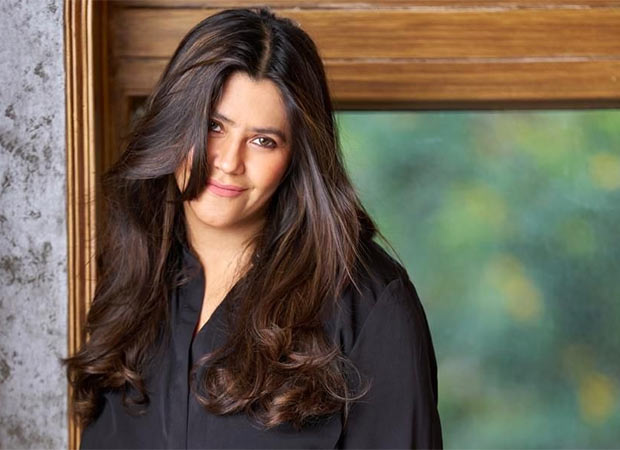
Ekta Kapoor believes that the rise of connected TV will bring a revival of women-led, urban-mass storytelling in the digital space, a segment she feels was largely overlooked when streaming platforms primarily targeted male audiences. She shared these insights during a fireside chat with YouTube India director Gunjan Soni at the CII Big Picture Summit 2025.

Soni opened the conversation by introducing Kapoor as one of India’s most influential media creators, highlighting her “unconventional and inspiring” journey. Kapoor reflected on how she entered the industry at 16, joining her father Jeetendra’s early production company.
Her first real opportunity in drama, however, came only after considerable struggle. Many broadcasters dismissed her as “too young” to manage primetime storytelling and steered her toward comedy instead. Her eventual breakthrough in drama was unexpected and came from the South, after veteran icon Rajinikanth supported her work.
Kapoor revealed that the emotional core of Kyunki Saas Bhi Kabhi Bahu Thi stemmed from observing the subtle, often unspoken dynamics between mothers-in-law and daughters-in-law. She explained that while men are typically expected to pass down their legacies to sons, daughters-in-law are often expected to leave their own families behind and fully integrate into new ones, also absorbing the emotional baggage carried by their mothers-in-law.
“What is natural is expected of men. What is unnatural is subjected to women as a societal norm,” she said. “It’s not that anyone is bad. It’s the unnatural expectations society places on women.”
Once she understood that “primary emotion,” Kapoor said, the show became deeply rooted in Indian homes, “Once you catch a primary emotion, you catch a home.”
Kapoor also shared a glimpse of the new season of Kyunki, describing it as a modern take on the beloved character Tulsi. Now older and more nuanced, Tulsi reflects the insecurities and humour faced by contemporary women, from fitness concerns to changing family roles. In one scene, Tulsi steps onto a weighing scale, is surprised by the number, and jokingly claims the scale is broken. “I do that very often,” Kapoor quipped.
In another moment, Tulsi’s daughter gently points out that her blouse doesn’t fit. Kapoor noted how relatable this is: “We do it so often with our mothers,” she said. “Without realizing you’re somewhere feeding the insecurity of the other person.”
Discussing the impact of digital platforms on storytelling, Kapoor noted that OTT services initially focused on male audiences, as subscription models tended to align with male viewing habits. In contrast, television, driven by advertising, has traditionally catered to women.
With connected TVs now approaching 100 million households, she believes digital content will finally return to advertiser-driven programming for the urban-mass female viewer. This, she said, will pave the way for new genres, midlife dramas, workplace stories, and gentle romances. “We call them Korean dramas now. I call them the Korean dramas that were Indian 10 years ago.”
She added that digital platforms have been “unfair to women” by sidelining female-focused narratives, while television has historically underserved men. Connected TV, she believes, offers a course correction.
Kapoor also opened up about working in a male-dominated industry where “conversations happen on golf courses and dining tables you are not at.” Her solution: foster strong networks among women while being inclusive of men. “We need more women in leadership roles,” she said.
Her message to women entering entertainment was direct, “There’s no seat at the table? Bring your own chair, or set up your own table.”
On taking risks, Kapoor said her courage was shaped by failure. Early in her career, she followed conventional advice and ended up with “one of the biggest flops ever.” That experience taught her to rely on her own judgment. “You need to make a decision and go ahead and do what you need to do. And then face the consequences,” she said. “There is no other way to be.”
The post Ekta Kapoor gets candid on the future of digital entertainment; says, “Connected TV will bring back the Indian woman to the centre of storytelling” appeared first on Bollywood Hungama.