Srinagar, Dec 4: Each morning, Kashmir wakes up under a man-made dusk, its roads roaring with machines that keep the economy alive but the Valley breathless.
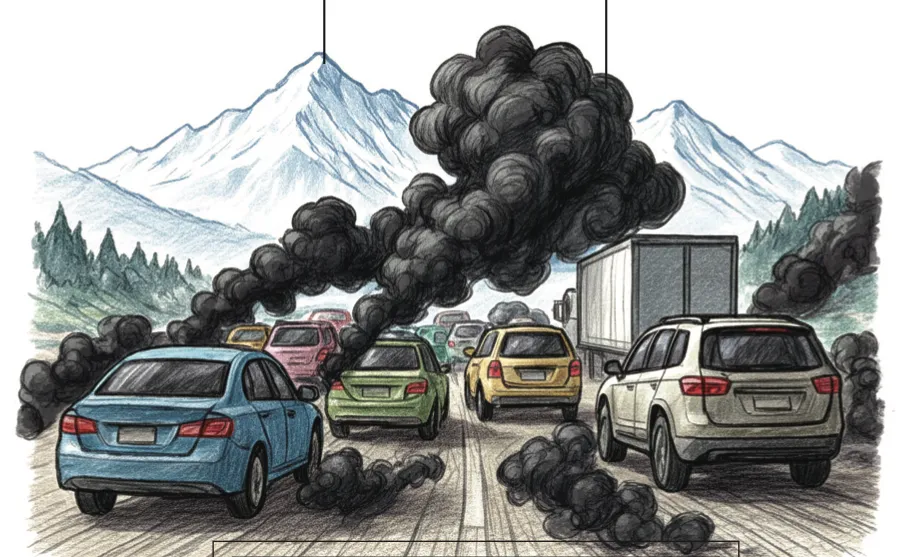
A booming Rs 964-crore auto industry powers J&K’s coffers, but its fumes now cloud the mountains, trap poison in winter air, and turn the Valley into a year-round gas chamber, an environmental crisis hiding in plain sight on Kashmir roads.
The Valley, especially central Kashmir, is choking on its own breath, with air so laden with particulate matter that even midday looks like dusk.
While the winter chill may sharpen the sting of Kashmir’s air, pollution here isn’t seasonal.
Vehicles – the hundreds of thousands of exhaust-fuming machines – are among the primary causes of the persistent “bad air” in the bowl-shaped Valley.
From the diesel growl of minibuses, trucks, and other load carriers to the endless ant-army of small and big vehicles, sedans, and SUVs, toxic smoke keeps billowing into the air year-round.
As of October 2025, Jammu and Kashmir had over 25.6 lakh registered vehicles.
According to the Motor Vehicles Department, the number is nearly double the 13.6 lakh registered vehicles in 2016.
According to national surveys, J&K has one vehicle for every four residents.
Then come the two-wheelers: Srinagar alone claims about 3.15 lakh of these.
Although a good proportion of the new two-wheelers are electric, a large number of fuel-based motorcycles and auto-rickshaws still exist.
And the emissions from these vehicles go into the cauldron of Kashmir. The Valley is a geological trap: an elongated basin, 135 km long and 32 km wide.
It is lined by the Pir Panjal range to the southwest and the Greater Himalayas to the northeast.
These mountains rise like sentinel walls around the Valley, towering up to 4000 meters and more.
This topography acts as nature’s pressure cooker for pollutants. Air masses, heavily loaded with particulates, swirl and settle in the lower atmospheric layers rather than escape. And in winter, when temperature inversions set in, the air gets even nastier – vehicular emissions are pushed closer to the Valley floor. Environmental scientist and Vice Chancellor of the Islamic University of Science and Technology (IUST), Shakil Ahmad Romshoo, has worked extensively on air pollution during the winter months.
His 2018 study, published in ‘Nature’, mapped how this geological setup amplifies PM2.5 levels to nearly five times the safe limit during cold months.
The auto-sector generates a major chunk of revenue in J&K. In 2024-25, a revenue of Rs 964 crore was generated through vehicle registrations, road taxes, permits, and fines by the Motor Vehicles Department.
Many environmentalists believe this massive contribution of the auto-sector to government coffers is the reason vehicular pollution is treated as the “elephant in the room.”
A 2022 compendium published by ‘Springer’ calls road transport the primary driver of urban toxins in Srinagar.
“Emissions released from vehicles are the principal sources affecting air quality, and their effective regulation is vital to safeguard the environment,” it reads.
It states that emissions like NOx and CO spike 30-40 percent during peak hours.
The researchers call for policy intervention and a deeper study of the effects of vehicular emissions on the Valley’s air quality. Last week, the Center for Research on Energy and Clean Air (CREA) showed how all districts in J&K have persistently poor air quality nearly year-round. Recent Air Quality reports depict consistently poor readings, with the Air Quality Index (AQI) exceeding 160 at Rajbagh, Srinagar – a pristine location surrounded by trees, with the Jhelum flowing nearby and abundant green spaces.
The post The elephant on Kashmir’s roads appeared first on Greater Kashmir.