From Earth orbit to the Moon and Mars, explore the world of human spaceflight with NASA each week on the official podcast of the Johnson Space Center in Houston, Texas. Listen to in-depth conversations with the astronauts, scientists and engineers who make it possible.
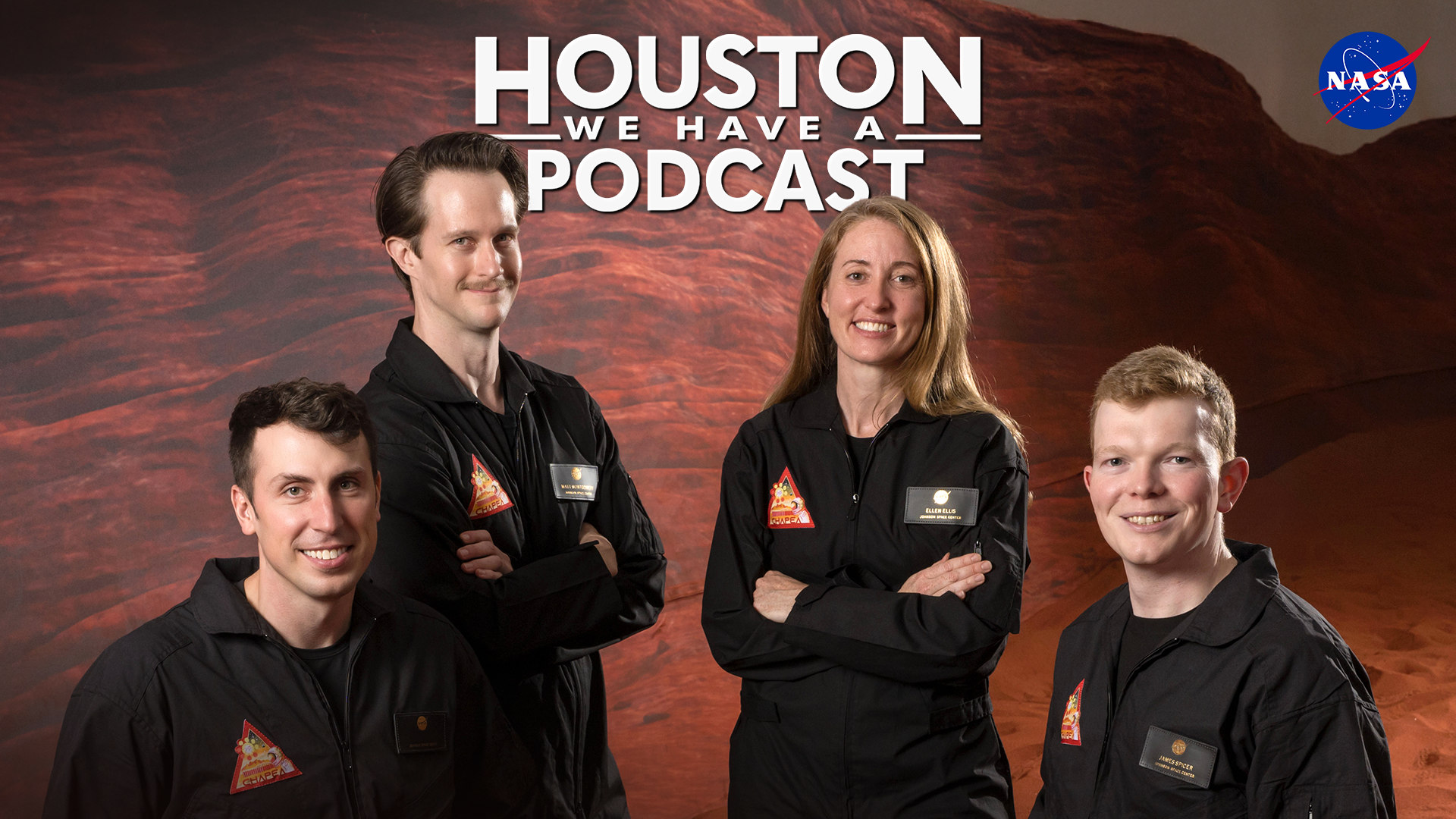
On episode 404, the CHAPEA Mission 2 crew discusses their backgrounds and preparations for their upcoming yearlong analog Mars mission inside the Mars Dune Alpha habitat at NASA’s Johnson Space Center. This episode was recorded October 14, 2025.

Transcript
Houston, We Have a Podcast! Welcome to the official podcast of NASA Johnson Space Center, Episode 404: CHAPEA Mission 2. I’m Kenna Pell, and I will be your host today. On this podcast we bring in the experts: scientists, engineers, and astronauts, all to let you know what’s going on in the world of human spaceflight, and more.
Four individuals recently embarked on a year-long analog mission in a habitat right here on Earth that will simulate very closely what it would be like to live on Mars.
The analog mission is called CHAPEA, or Crew Health and Performance Exploration Analog. The primary purpose of this study is human research –
CHAPEA was developed to enable an operational integrated evaluation of relevant human health and performance outcomes in relation to Mars mission realistic resources and constraints. The data from these missions will bring us forward on the path to Mars in response to a clear mission directive from the President to NASA.
This mission, facilitated by NASA’s Human Research Program, is the second one-year Mars surface simulation conducted through CHAPEA. The previous mission ran from June 2023 through July 2024, and we followed along with monthly check ins on this show.
On this first episode covering this yearlong mission, we were able to sit down with the CHAPEA Mission 2 crew to gauge their thoughts and get to know them a few days ahead of their first day of 378 in the 1,700-square-foot Mars Dune Alpha analog habitat here at Johnson Space Center.
Let’s meet the new Martians!
[Music]
Before we chat with the CHAPEA mission crew, let’s take a moment to outline their backgrounds ahead of their yearlong simulated journey on Mars:
The four research volunteers that have been selected are very astronaut-like, and agreed to participate in this ground-based study in the name of science.
The CHAPEA Mission 2 Commander is Ross Elder. From Williamstown, West Virginia, he is a major and experimental test pilot in the United States Air Force. At the time of his selection, he served as the director of operations of the 461st Flight Test Squadron. He has piloted over 35 military aircraft and accumulated more than 1,800 flying hours, including 200 combat hours, primarily in the F-35, F-15E/EX, F-16, and A-10C. His flight test experience focuses on envelope expansion, crewed-uncrewed teaming, artificial intelligence, autonomy, mission systems, and weapons modernization.
Elder earned a Bachelor of Science in astronautical engineering from the U.S. Air Force Academy in Colorado Springs, Colorado, and commissioned as an Air Force officer upon graduation. He earned a Master of Science in mechanical engineering from the University of Colorado in Colorado Springs and a master’s degree in flight test engineering from the U.S. Air Force Test Pilot School at Edwards Air Force Base in California.
—
Ellen Ellis is the CHAPEA mission 2 medical officer. From North Kingstown, Rhode Island, she is a colonel and an acquisitions officer in the United States Space Force. She currently serves as a senior materiel leader in the National Reconnaissance Office (NRO) Communications Systems Directorate. She is responsible for fielding commercial cloud and traditional information technology hosting solutions and building modernized data centers for the NRO.
She previously served as an Intercontinental Ballistic Missile operations officer and GPS satellite engineer, and she also developed geospatial intelligence payloads and ground processing systems. She earned a Bachelor of Science in aerospace engineering at Syracuse University in New York and holds four master’s degrees, including a Master of Science in systems engineering from the Naval Postgraduate School in California, and a Master of Science in emergency and disaster management from Georgetown University in Washington.
—
Matthew Montgomery is the CHAPEA Mission 2 science officer. From Los Angeles, he is a hardware engineering design consultant who works with technology startup companies to develop, commercialize, and scale their products. His focus areas include LED lighting, robotics, controlled environment agriculture, and embedded control systems.
Montgomery earned a Bachelor of Science and a Master of Science in electrical engineering from the University of Central Florida. He is also a founder and co-owner of Floating Lava Studios, a film production company based in Los Angeles.
—
Last but certainly not least is the CHAPEA Mission 2 flight engineer James Spicer. He is a technical director in the aerospace and defense industry. His experience includes building radio and optical satellite communications networks; space data relay networks for human spaceflight; position, navigation, and timing research; and hands-on spacecraft design, integration, and tests.
Spicer earned a Bachelor of Science and Master of Science in aeronautics and astronautics, and holds a Notation in Science Communication from Stanford University in California. He also holds commercial pilot and glider pilot licenses.
—
Individuals like these represent, based on what we know today, the makeup of a Mars crew. During their journey, they will be put to the test by simulating how as a group they can deal with Mars realistic objectives and constraints, including resource limitations, communications delays, high-tempo EVAs, and other environmental stressors.
It was a pleasure to have the chance to sit with them ahead of ingress. There was a lot of energy and excitement ahead of their mission. Now that you know their general bios, let’s dive in a little more on who these folks are and what drove them to participate in such an endeavor.
Let’s go!
Kenna Pell
Ross, Ellen, Matt, and James, thank you so much for joining us on Houston We Have a Podcast. I can’t tell you how excited I am to talk to you ahead of this mission. Over a year, 378 days, right? And we’re just a few days ahead of Ingress, which is coming up on this Sunday. It’s just a few days away. So Ross, let’s start with you first, first, how are you feeling ahead of Ingress, and then describe your career progression and how you got to where you are.
Ross Elder
Absolutely, thanks for having us. I personally am very elated to get the mission underway, and I won’t speak for the crew, but you know, I’m quite eager to contribute to NASA’s long duration space exploration, and honestly, I’m probably far less nervous than I should be for a year away on Mars. And I’m sure some would say there’s a fine line between being intrepid and insane, but I consider myself incredibly grateful to be part of the exceptional crew, and just play a role with the massive support structure that put this whole project together over years and years of work. But for me, I’m a fighter pilot by trade, but an engineer at heart. So becoming a test pilot in the United States Air Force was kind of naturally the best fit for me, and in doing so, I had the privilege of working on a lot of unique experimental and developmental flight test across a large variety of platforms and programs. You know, from color night vision testing in Russian helicopters to human machine teaming with fifth Gen fighters and AI driven uncrewed combat platforms. So at my last duty station, finished up a tour as a director of operations for the F 35 Integrated Test force and certified as an instructor in the United States Air Force Test Pilot School.
Kenna Pell
Okay, and that was Ross. Should be a mission to Commander. How about over to Ellen, can you tell us how you’re feeling ahead of ingress?
Ellen Ellis
Yeah, absolutely. I’m feeling a lot of excitement as we get ready for Ingress this Sunday. I have a strong sense of purpose, I believe, in the work that we’re doing, and there’s a bit of introspection, I think, as I’m thinking about leaving my family behind and getting ready for the year ahead. So I’ve been fascinated by space since I was a little kid. My my dad would take me out in the backyard and point out constellations, and I’ve just always wanted to learn more. It’s just been an endless source of wonder for me. I learned that many astronauts had military backgrounds, so I joined Civil Air Patrol when I was a kid, and then Air Force ROTC in college, and that has just afforded me so many amazing opportunities to work on satellites over my career in the Air Force, and now Space Force. And I’m so excited that the Space Force has been very supportive of me taking part in CHAPEA Mission 2. So I feel really fortunate as well.
Kenna Pell
Awesome. Over to you, Matt, how are you feeling and how did you get here?
Matthew Montgomery
Yeah, thanks for having us, and I think prepared is the word I’m feeling right now. We’re getting pretty close. We’ve been working hard, kind of what everyone else touched on, little bit excited, little bit of introspection and nerves. Think those are all probably healthy at this point, right right before we go in. So how’d I get here? I’m an electrical engineer by education. I worked in a number of hardware startup companies, so always trying to develop new technology. I’ve touched a lot on robotics, that’s touched in a little bit of controlled environment, agriculture, a lot of consumer products, just taking designs from a concept and bringing them to reality. And then I’ve got this kind of other side that I split my time doing, which is film production. And a lot of people think that that’s a kind of a weird combination, but I think they’re really intertwined. So those are very similar. Like film is about coming up with an idea or concept and working to bring it to reality in the in the real world. So kind of that that mix is kind of led me here.
Kenna Pell
Okay, How’d you know I was gonna ask about that. And that was Matt. He is the CHAPEA Mission 2, Science Officer. And now over to James, who is the CHAPEA Mission 2 Flight Engineer, James, can you tell us, first of all, how are you feeling ahead of ingress?
James Spicer
Absolutely. Yeah. Much like my crew mates, I think a mixture of excitement and and a bit nervous and trepidatious about spending 12, 13 months together in a box. But the last few weeks of training together have been really exciting. We’ve been getting to know not just each other very well, but also the habitat where we’re going to be and all the work we’re going to be performing while we’re in the mission by training. I’m I’m a career aerospace engineer, so I studied that in college, and that’s been my career so far. Mostly the area that I work in is satellite communications, and so I’ve spent my whole career basically designing communications architectures to enable satellites to communicate with each other, with the earth, and most of the time that space data relay systems around the Earth, similar to the ones that, for example, the International Space Station uses to talk to the mission control here In Houston, but also working on lunar architectures as well. So it’s an interesting reversal, where I spent my career designing communication systems, dealing with bandwidth constraints, designing latencies, and now I get to live on the other side of that, where we’re under, of course, a very heavy latency constraint and bandwidth constraints as well.
Kenna Pell
Okay. Thanks. You all bring all different backgrounds into this 378 day mission. And I want to hear about, how did you find out about it? There was the first mission, right? And I think a lot of people heard about it once that crew came out of the Mars analog, the Mars habitat. How about James? Let’s, go back to you. Where did you hear about this opportunity, and maybe tell us about the application process?
James Spicer
Yeah, well, you nailed it on the head. So Mission One, of course, happened between 2023 and 2024 and I remember I heard about the mission while it was going on. Followed the mission throughout the 12, 13 months that it was going and was reading the reports, reading about all the science and the work that they were doing. And thought this would be a really cool.
Kenna Pell
Were you hearing the podcast?
James Spicer
I was absolutely hearing the podcast! And it seemed like a really cool opportunity, and a really great opportunity to contribute to NASA’s moon to Mars program. And so I actually set up an alert so that when the applications for mission two came out, then I’d get an email or a ping or something. And so back in March 2024 was when they released the applications for CHAPEA mission 2. So I applied then, and then it was quite an arduous process. We were calculating it’s been about 19 months since we first applied to when we will actually start this weekend.
So we applied in March 24 we put in our resumes, we answered some questions about whether we like being by ourselves, whether we like working in teams, how we coped with covid lockdown, which this experience will not be entirely dissimilar to. I believe maybe three months later, they put us through a physical test make sure that we were fit and healthy and able to meet the requirements. In November 2024, they brought us on site to NASA Johnson, and we were down to say 20 candidates at that point. And we we met the scientists, we met the researchers who will be conducting this experiment, and we underwent a lot of psychological and also physical testing. But it wasn’t just that NASA was evaluating us. They were also very keen that we evaluate them and we take a look at the habitat. And we actually had an experience where we got to eat some of the same food that we will be experiencing. The general idea being that if we didn’t like the look of the hab, or we couldn’t stomach the space food, then maybe this wasn’t a good fit for us.
Back in January, NASA sent the final candidates to the National Outdoor Leadership School in Wyoming, also known as NOLS. And this was a really important milestone for us, because it was the first time we all got to meet each other, and the first time we got to work together as a crew. And this was the middle of winter, and we went on a cross country skiing and back country camping trip for about a week. And there were 10 of us on that trip, and we basically spent the time getting to know each other, dealing with a similarly austere resource constraint and quite stressful outdoor environment, which on Mars, of course, will be a very dry desert like place, with the atmosphere In Wyoming, a similarly desolate, featureless environment, very cold, obviously. We also had 40 inches of snow dumped on us while we were out there. But that was a great opportunity to get to know the team, get to figure out what it’s going to be like to work together, how each of us likes to work, how we communicate and that was really the first time where we got to work together as a crew, which was great. Then we were selected, or we were notified of our selection in April of this year. Training began in mid, mid September this year, and after five weeks of training, we’ll be ingressing on Sunday. So about 19 months, end to end.
Kenna Pell
Wow. Thank you for going through that whole timeline. That was really helpful to understand. But 19 months, wow. And I love that you had that alert set up to actually hear when the applications were opening again. That’s awesome. Back to you, Ross, can you tell us about your application process or what made you want to apply? How did you find out about the opportunity?
Ross Elder
Sure, you know, while the first CHAPEA mission was ongoing, that you know, the application went to open, as James alluded to and several of my family and friends kept forward to me the articles and the application link over and over and over again. And finally I yielded, and figured I’d throw my name in the hat. And as James said, like, a year and a half later, here we are. So didn’t set up any alerts for me, but…
Kenna Pell
Your friends were.
Ross Elder
Absolutely right.
Kenna Pell
Why did they what is it about you that your friends kept, you, know, sending that your way and maybe, how did they hear about it? Or why did they think you were a good fit for it?
Ross Elder
Well, besides, you know, some of the, you know, military background where, you know, this isn’t foreign from deployments and those kind of concepts, I also have spent the last six years living in an Airstream, so, you know, confined in isolated environments. You know, even though it’s more glamping than the Mars Dune Alpha that will be in it was, it was a similar vibe. So there were some parallels, for sure, that family and friends identified pretty early on, and they’ve known from me as a as a child, that I always wanted to contribute in some way, shape or form in the aerospace industry. And so this was a good opportunity.
Kenna Pell
I love that. Yeah, he was a good support system, good friends to be sending you that. How about Matt? You tell us about your application process?
Matthew Montgomery
Yes, mine was somewhere in between. I had caught some information on the other analogs, HERA being one of them. So I was, you know, very aware of the analogs that were happening at NASA. So I was definitely following the space program over the last like, let’s say, 10 years, pretty well. And Google does a good job of forwarding things. I think that’s how I first found the application. I was aware that, of Mission One, so I caught some of the end podcast of that one. So I was definitely interested in CHAPEA specifically. So I was, you know, similar to James, like didn’t have the alerts set up, but was was looking, and I saw it pop up on one of my my feeds, and pulled open the application, and it had a lot of questions on it. They were like, short answer essay style questions. So I skimmed through them really quickly to see what that looked like, and just reading them like I had that feeling right away, I was like, “Man, this is a really good fit for, like, my personality and my background.” And then I ended up showing it to like my girlfriend later, and she looked through it and had that similar kind of response like, “Oh, wow, I think you’re a great fit. You should apply.” So, yeah, filled that one out pretty quickly thereafter. And yeah, as James captured nicely, went through that process.
Kenna Pell
Exciting! Okay, last but not least, Ellen, who is the Mission 2 Medical Officer, right?
Ellen Ellis
Yeah, that’s right.
Kenna Pell
Can you tell us about your experience?
Ellen Ellis
absolutely, yeah. Actually, I saw a LinkedIn post from an Air Force colleague that I had deployed to Iraq with back in 2007 it coincided in time with the astronaut application, so I was working on both simultaneously, but I remember, similar to Matt seeing the application, there were a lot of questions about living and working in confined spaces, and my first duty assignment in the Air Force was working at Minot Air Force base as an ICBM combat crew member and working in a very small, confined environment. And by comparison, the hab just seems luxurious. So seemed like a good fit for me as well.
Kenna Pell
I love that. Thanks for sharing. I want to ask you all, what was it like when you got the call? How did you respond?
Matthew Montgomery
Yeah, I’ll jump in on that one.
Kenna Pell
Did you answer the call? Hopefully-
Matthew Montgomery
A lot of them weren’t calls…
Kenna Pell
The email! Was it? Be real, okay.
Matthew Montgomery
Yeah, it’s always like a progression I think James captured a lot of it nicely. Where you’re clearing gates is maybe the way I would definte it. Where you get a response. So you put the application in and you have no idea whats gonna happen next. It kind of goes into the void is the way I think about it. And you just hope something comes back out of that void. So the first time I recieved a response about doing some medical evaluations. Like, that’s quite exciting, where you go at least I cleared a hurdle. And it kind of feels the same way the whole way through you’ve just made it past hurdle after hurdle after hurdle. And you’re just on this kind of marathon journey and hoping to keep clearing hurdles, but every time you do it’s more and more exciting. Cause you want to make it to the mission. You want to be able to make the contribution. And we’re close to another hurdle. Getting to ingress, and getting through training. So that’s kind of the excitement piece we were talking about earlier, that’s the building piece, clear this next one, and start another.
Ellen Ellis
So I, I clearly remember the the first week of interview, Ross and I interviewed the same week. I was just so impressed with the professionals that were also going through the application process. Incredibly diverse backgrounds, really intelligent, smart people that I would gladly be in habitat with. And I just remember feeling like, oh my goodness, this is so exciting to be part of this interview round. And if I can just get to NOLS, we’ll call it a win. So everything, everything since then, has really just been icing on the cake. So super excited.
Kenna Pell
I love it.
Ross Elder
I agree the in terms of answering the call when we did receive the email, I, ironically, was airborne at the time at Edwards, flying a test mission in F-35 and so it was many, many, many hours later that I found out from, you know, the Email and and some of the group chats that we had from the candidates for our initial interviews. And ironically, it was not my, you know, family and friends that heard about it first. It was the air crew flight equipment that heard me screaming about how excited I was when I read the email.
Kenna Pell
Yeah. James, what about you?
James Spicer
Yes. Well, I was just gonna mention, as you go through those gates, as Matt mentioned, presumably quite a wide filter is then narrowing down. You’re getting further and further in the process. At each stage, the excitement grows, but also the concern from one’s family and friends grows. And so when I first put in my application, my family was thinking, wow, yeah, this would be really cool. Good on you. And then you get to the physical and then you get to the on site interviews. And now the family is thinking this might actually happen. And by the time we went to NOLS, you know, I was sitting down with my family members thinking, Okay, if this does happen, how are we going to manage this? How are we going to communicate, etc. And then when I finally got the email back in April. It was almost bittersweet, because I’m extremely excited about it. I’m bouncing off the walls, as Ross was saying, but then it’s also, okay, now I have to inform my family that I’m going to be gone for a year, and of course, that’s going to take a toll on them. It’s going to take a toll on me. It’s going to change the relationships. And so it was interesting seeing the two sides of that.
Kenna Pell
I don’t even have to segue. How did you know that was the next question. You’re so good at this. Okay, so I was just going to ask. You know, having to get your life in order to prepare for being away from home for a year is not only just logistics, but, you know, preparation with your families. Ross, how about, how about you? How did that go?
Ross Elder
Yeah, so for me, it’s, you know, eerily similar to a military deployment. So logistically speaking, you know, we pack our bags and sure that you’ve dotted your I’s and crossed your T’s in terms of financial, legal, medical, etc. And then once you know, the mission date was officially announced, it was go time, but from the family and friends perspective, the separation is definitely going to be a huge challenge. But I have to give a shout out to the great folks here at JSC, because they’ve been doing a fantastic job on both training and preparing us and then speaking directly with our families to help support them, you know, while we’re here, through training and all the way through the mission.
James Spicer
I was just going to add a bit. So, as Ross mentioned, you have to pack your bags. Move out of your apartment if you have one. Think about that. But also, because we are going on a Mars simulation, there are certain other aspects. Because of the time delay, and we don’t have access to real time mail, I’ve actually pre written birthday cards, and I have a couple of weddings that I’ll Be Missing unfortunately due to my participation in this mission. So I’ve set up wedding gifts and and wedding cards as well. So something else that we have to consider due to the isolation on the distance of this mission. For example, we won’t have access to any sort of mail address or any sort of real time access to the internet, and so that adds a whole other dimension to things. So for example, we’re not able to fill out tax forms. For example, we’re not able to receive tax forms. Two factor authentication doesn’t work on Mars because you don’t have any real time access. And so there’s been several things that I think we’ve all been trying to figure out, how do we set up make sure that either we can do that remotely, somehow, or somebody else has access to all of that and can do it for us?
Kenna Pell
Got it? I would not have even thought about those things. Oh my gosh. When you’re thinking about, you know, a year in the future, I can’t even plan my month ahead. I feel like, How about over to you, Matt, what have you been doing, logistics and family planning for your year on Mars?
Matthew Montgomery
Yeah. James, totally covered a great aspect of it. I co own a business with my partner, so that’s been a big piece of our preparation, since we won’t have that real time communication, is she set up to run all the aspects of it, the two factor authentication, I think such a great example, you know, is an account held in one person’s name or or not. Is it in both? So we’ve been doing testing on that month over month, just to make sure we’ve captured them all, you know, like powers of attorney, like you got to think at a legal level, like, can somebody handle your business? Much like James was saying there too. So there’s that aspect of it, and then I think there’s the personal aspect of it, like, what communication systems are you setting up with your friends and your family? How are you going to maintain that connectedness and integration there? I think all of us have kind of come up with different strategies. One of the ones that I’m thinking about using is just kind of keeping a highlight log or a running log in, like a Word document, and sending that out at some frequency to try to give people an idea, in my family and friends, what what life’s kind of like, since we won’t have a lot of opportunity just based on the the maybe pace or rapidness of our schedules, just a quick jot down of a note, I think will maybe bring some of that reality out to friends.
Kenna Pell
What a wild concept to you know, wrap my head around is having to think through some of these things, owning a business, co owning a business, and thinking ahead to the year. And how do you explain to people that, you know, I’m going to Mars essentially for a year. Um, how about training? So, James, with your great setup of the timeline, it’s been 19 months to get to this point, but you arrived here on site. Did you say about five weeks ago? Okay, and so how about Ross? We go to you. Do you want to tell us a little bit about the training and preparation since you stepped foot here on site at Johnson?
Ross Elder 25:24
Sure, yeah, to kind of set the scene, to understand, you know, what’s kind of asked of us, and you know what direction we needed to get to go in with the training and preparation. So this mission allows us to test technologies and food systems and assess physical and behavioral health patterns in a controlled setting, aiding NASA to have an ability to identify, characterize and field countermeasures to risks that were associated with some of these long duration space missions. And with that comes a lot of stressors. So the key stressors that CHAPEA expects to attack directly include things like resource limitations that we’ve hit on in a little bit isolation and confinement, equipment failure simulations, communication delays and simulated space walks. So with that, you can imagine all of the things that we’ve needed to cram in five weeks to help prepare us around those stressors. So a lot of the time has been spent in terms of understanding those stressors, what things we can do as individuals in a crew to counter those stressors, and then really just understanding the basic systems that we’re going to be operating with that help us meet those, those key objectives.
Kenna Pell
Ellen, how about you with the training and preparation? Has there been anything that surprised you? Or…
Ellen Ellis
Yeah, actually, a few things I’m excited about. So as the medical officer, I come with a background in engineering, and I’ve worked on some hardware and software before that were adaptive technologies, but I’m really looking forward to some of the interesting tools that we’ll be using for medical diagnosis. So I’m really looking forward to that. We’ve had a few training events, and so far so good.
Kenna Pell
Okay, Matt, do you want to share about your training and preparation?
Matthew Montgomery
Yeah, painting a little bit more context off of what Ross was saying, if you think about all of those areas that he mentioned, there are individual teams here at NASA Johnson and at some of the other agency locations that are supporting us in these different learning environments. So they have to distill down all the information that they need us to learn in this period of time so that we can basically pick up the torch and carry it forward when we go on a mission, since we’re going to have that isolation component and that lack of real time communication, so they’re spent their time trying to build that independence in us. And you know that there’s a lot of work on the front end coming from them, just to prepare the materials and the training. So, you know, just a lot of thanks going out to those teams to get us to the point that we’re at. Coming back to some of the things that I’m excited about. So as a science officer, there’s some specific tasks related to plant growth. I’m very excited to dive into some of that. That mirrors some of my controlled environment agriculture background, if we think about plant growth in space, that’s a very resource intensive activity, both from like a mass perspective, and figuring out what masses are worthwhile to bring with you on a long duration mission is definitely one of the objectives, of this mission. So, you know, I hope to contribute good science in that respect, to help them decide what those resource trade offs might look like. Same thing on some of the science fronts with geology, I’m interested in getting in and contributing on that front as well.
Kenna Pell
Awesome. James, what about you?
James Spicer
Yeah. So as everybody said, what makes this mission unique is that CHAPEA is very much about the integration of lots of different types of data. So as NASA looks to going back to the moon, beginning next year with the Artemis II mission, and looking towards going to Mars in the 2030s there are many, many different teams within NASA who are all involved in planning what those missions are going to look like. Everything from how much food do you have to bring, what sort of exercise equipment do you have to do, what sort of psychological support do you have to be able to give the astronauts who will be isolated for so long? And all those teams have been working independently, but CHAPEA is really the first time that all those different disciplines are being brought together. So what CHAPEA does is give NASA and all these different individual teams the ability to understand how one piece of the system affects all the other pieces. And so as everybody’s been saying, it’s been a lot of integrated training, where we’ve been learning how to prepare food, how to exercise properly in order to maintain our fitness, how to do the EVA’s or the Extra Vehicular activities, or space walks, to be able to give the scientists the resources they want in a representative astronaut like way. So we will be undergoing a representative astronaut-like schedule. So we’ll be performing science experiments, we’ll be doing EVA’s. We’ll be doing exercise as well as working on personal time. So it’s been really interesting, getting to do training in all those different areas and and we’re excited to put it all together.
Kenna Pell
I think you guys really did a good job touching on a lot of the things that you’re going to be doing. Like you had mentioned, some of the plant biology, science and stuff like that too. Do want to talk about some of you know how you’re gonna be spending your time and personal goals and things like that. But first, want to talk about what makes a good Mars crew. Ross, let’s start with you. How would you describe yourself and your personality?
Ross Elder
Now, I don’t know if the crew will entirely agree with these comments, but I would like to think that, you know, I’m rather adventurous and kind of extroverted and on that end of the spectrum. But I do think they will agree on that I consider myself quite the problem solver and very task oriented. But I definitely would give a shout out back to the crew, because without them, I would be nothing so like James keeps me grounded. Matt keeps me focused, and Ellen’s always there to share empathy even in the most trying and challenging moments.
Kenna Pell
That was a great answer.
Ellen Ellis
He didn’t mention humble, by the way, I feel like that should be on there.
Kenna Pell
Absolutely and as commander of the mission, what is your approach to being a good teammate?
Ross Elder
I think it’s important to have a shared mental model. In other words, understanding like the team’s collective goals is critical for us to each individually be an effective team member, but honesty and integrity goes a long way, and that includes playing to your strengths and admitting to your weaknesses. And at times, each crew member is going to play a leading role, and other times will be in a supporting role, and that includes myself. And maintaining awareness of the crew dynamics as those are ever changing is critical, and we also have to have the appropriate soft or interpersonal skills to maintain that communication when there is conflict, so that we walk out as a cohesive team.
Kenna Pell
Do you have any role models?
Ross Elder
I do, and he probably doesn’t know this, but my cousin is my role model, and he kind of paved the way for young, like minded men like myself out of West Virginia. And before I was a teenager, I went on a road trip with my dad to see my cousin graduate from the Air Force Academy, and then he went on to become a pilot. But the graduation ceremony with the Thunderbirds flying overhead with an aerial demonstration is definitely one of those core memories that I will never forget. And little did I know that I too would get some graduation ceremony that’s very similar when I graduated from the academy and went on to fly as a test pilot in the same F-16s that flew overhead, and I get to call several Thunderbirds my close friends this day. So kind of a cool thing to see it go full circle. And to this day, my cousin’s still flying globally, and he truly reinforces my love for aviation and aerospace.
Kenna Pell
Love it. Ellen, same set of many questions I just asked. First, how would you describe yourself? And then, what is your approach to being a good teammate?
Ellen Ellis
Yeah, to quote Mr. Rogers, I think I’m a helper. I think that self management, self discipline, is something that I see in myself, and I see reflected in my teammates as well. And as Ross said, creative problem solvers. I think we’re going to, I think we’re going to do pretty well with all the challenges that are put ahead of us in the coming year.
Kenna Pell
And do you have any role models?
Ellen Ellis
Yeah. I do. The military women who have served in space. Chief among them is retired general Susan Helms. She’s working today on NASA’s Aerospace Safety Advisory Panel, or ASAP. That does incredibly critical work for NASA today. I had the pleasure of working for her while she was serving on active duty. I just incredibly impressed by her integrity and the human that she is.
Kenna Pell
Love it. James, describe your personality and what makes a good teammate?
James Spicer
Well, I think many of the adjectives I was used to use to describe myself have already been used by my crew mates. I think it’s very important for an individual crew member to be organized, to be disciplined. I think that’s important to be able to follow procedures accurately. I think what we’re doing, it’s often an interesting mix between being very slow and methodical when it comes to following procedures, but also being able to make rapid decisions, sometimes very quickly and with limited information. As Ellen mentioned, I think what we do very well is we’re all good at asking each other for help. We’re also very good at offering help. And I think what’s also important is we know when to leave each other alone. You know, let them cook and just get on with it, because we’re all pretty competent in our own ways.
James Spicer
What we learned at NOLS, and we’ve been trying to reinforce during the training is putting the mission and the team above, you know, one’s own personal needs and goals and as a crew, I think what’s very important is, when you talk about the ISS the space shuttle, even going to the moon, you have that real time link with mission control. So if you need help, you can often get it in pretty quick time, and you can have people on the ground guiding you through things. When astronauts go to Mars, you’re going to have a time delay that’s anywhere between 13 to 22 minutes. And so crews will have to be much more autonomous and be able to make decisions, be able to react to scenarios by themselves, without the help of Mission Control and subject matter experts on the ground. It’s very possible, and we’ve been experiencing this where we could come across a problem, have put together a solution and solved it by the time Mission Control gets the first notification that we’ve come across the problem. And so that’s a real difference that future Martian astronauts will have to face and that we will have to face as part of this simulation.
Kenna Pell
Tell us about any role models that you have.
James Spicer
I mean, of course, all the great space farers of the past and present that that my crew mates have mentioned, I’m very lucky to have a lot of scientists and technical people in my family who I’ve grown up around and have been able to learn from and work with. And I’ve been very lucky to have a number of close mentors over the years, professors in college, teachers you know from the earlier stage, who reinforced my love for for maths and science and fostered my interest in space.
Kenna Pell
Got it. Matt, how about you?
Matthew Montgomery
This is a tough crowd to follow up on because they always give such thoughtful answers. I think that maybe touches on before I talk about myself like you only have certain number of chances throughout your life to be involved with really incredible teams, and you don’t know when those are going to pop up. And this, for me, is one of those moments like this. Is an absolutely incredible crew to be involved with. So when I was thinking about, you know, how do you describe yourself? Like a lot of the same qualities in me I see reflected in all my crew mates. So it’s an easy one and a hard one to answer, but I think you guys had touched on it pretty well. A few other ones that I think we all display, and myself included, we’re all very competent people, and we’re all very fast learners, maybe touching on what James said. We have a lot of intentionality, and that can play out in both ways. Like, like he said, You can be intentional in deciding that you need to move quickly and make a decision so it can. It can show up in in unconventional ways. I think I’m personally a pretty easy going type of person. I think all of us are as well. And, uh, yeah.
Kenna Pell
Got it so spending your time 378 days on this mission. Do you have any personal goals? Matt, how about you?
Matthew Montgomery
Yeah, personal goals, I’ve been thinking about my personal goals, kind of in two categories. There’s personal goals related to the mission. So at the end of the day, when I look at what we’re here to do, we’re, you know, essentially, test subjects. And the goal of being a test subject is to provide the data to all of the teams that have asked us to be here. So I think about that every day, whether we’re providing biological collections early in the morning, am I hitting those procedures correctly? Am I providing that data, not just giving it, but giving it in the way that it’s been asked to be given? So I think all of us have said this, but ultimately, that you know that my real goal here is just give the data, provide the data to the best of my ability, and I’m going to use that, you know, as a driving force throughout.
Maybe on the personal side, I’ve been pondering this question. I like the idea of of culture, like Mars culture. What does that look like? What might it look like? I think any time you have people or humans somewhere, you have unique culture, and we’re going to have the opportunity as a team to develop culture in the habitat, and maybe that can have an influence on where culture for future space travel, future Mars travel goes, and just having some influence, or at least thoughts and intentionality around that, I’m interested in exploring that over my time here.
Kenna Pell
Love it. Ross, how about your personal goals?
Ross Elder
Yeah, as Matt alluded to, there’s kind of, you know, different categories of goals, so you know, specifically to the role, like as the commander, my personal objectives ensure the safety of the crew. So I expect to lean heavily on, you know, past experiences and these diverse and extremely capable crew members to make some tough decisions when they when they pop up throughout the mission. You know, more of the professional side of things. As a tester, again, it’s to provide the best possible data to NASA that Matt kept hitting on, because this is going to inform future crewed, long duration space exploration missions, and we have to characterize all the risks that are associated with that. So there’s kind of a big ask for us to make sure that we’re following those procedures and getting the best data possible. But one definite objective that I have is that when we walk in on Sunday, hand in hand, that 378, days from now, we still walk out hand in hand the same.
Kenna Pell
James, how about you any goals
James Spicer
You’re not gonna mention the banjo?
Ross Elder
That’s a future question.
James Spicer
I think my crew mates have hit on the biggest piece, which is, of course, that there are many teams within NASA who are relying on us to provide them with data that will be extremely important as NASA designs its future roadmap for getting to Mars and designing those particular missions. So our primary goal is to do a good job provide the teams with the data they need, whether that’s on how we’re reacting to stuff, how the equipment works, how the mission is designed. So I think for me, certainly, I think for me, certainly, I think for most of us, that’s the driving force. As Ross mentioned, I think we’re going to get to know each other extremely well. The friends in my life that I’ve had for the longest are the ones with whom I’ve lived, shared classes, shared experience with. So one of my goals not just for the next year, but I really hope that in 10 years time, we’re having a reunion dinner and reminiscing about the good times we had in the Hab.
Kenna Pell
Love that. Ellen, how about you? Any goals you want to share?
Ellen Ellis
Yeah, absolutely, accomplishing all of our mission objectives. My goal is to produce as much data as possible. Over the next year, we’ll have opportunities to provide feedback on the Hab design. I’m very interested in some of the human factors, aspects of this living environment. How does the lighting and temperature and our workload impact our cognitive performance? I think these are things I’m just intellectually curious about and excited to see how we do another personal goal that I have is to stay connected with my family while I’m while I’m away, identifying different scheduled techniques that I can use to connect with my husband, connect with my parents and friends, and just make sure that everyone at home knows how I am, and that’s important to me. I think it’s important to them, and also the importance of us staying connected as a team. So those are, those are the important things to me.
Kenna Pell
I love it. Someone just mentioned banjo. So leads into our next question, how will you be spending your off duty time?
Ross Elder
So one thing to note, though, is that we have dozens of integrated experiments that we’ve been talking about up to this point, so our days are going to be scheduled very thoroughly, and it’s going to keep us quite busy. So just like the astronauts on the ISS and we expect to be spending lots of times doing those activities, like those EVA science and engineering work, habitat maintenance, participating in lots of physiological, biological psychological studies. However, I did bring an excessive number of books to read, hopefully working on language study, some professional development, and I think we have all of the movies. But I will say I don’t think Ellen knows this fully yet, but we’ve already formed a band, so we’ve got a banjo, a keyboard, and a couple harmonicas, and of course, Ellen at the mic, and the band’s name is Ellen and The Boys (working title).
Kenna Pell
Nice.
Ellen Ellis
I’ll bring my, I’ll bring my kazoo.
Kenna Pell
Yeah, wait so you’re on banjo, and then James… did you say harmonicas? What did you say?
Matthew Montgomery
Yeah. He said harmonicas.
Kenna Pell
You’re acting like… you’re prepared for this, right? You play the harmonica?
Matthew Montgomery
No… But we’re bringing it.
Ross Elder
We’re bringing it and we’re figuring it out.
James Spicer
One of Matt’s personal goals for the year is to learn the harmonica.
Kenna Pell
Well, Ross did look over at Matt when he mentioned movies. How do you think you’re gonna spend your time, or how are you planning to spend your off duty time?
Matthew Montgomery
Yeah, I think. Ross hit on it really well. Just the mission focus on the schedule. When you first see it, you go, when are we going to get anything done? And it just speaks to the seriousness of the pace and the mission tempo that will be expected of astronauts that do traverse to Mars. So I think, you know, paying special attention to that is very important, but there will be downtime, and you do need recovery. But, yeah, I think on the recovery side, I’ve got a list of books that I want to get through, a little bit of non-fiction, and some areas that I’ve been interested in, just in general. Space history, a little bit of the geology of Mars. It feels fitting to work some of that in as we’re like immersed in this fire environment. And then, yeah, on the on the more leisure side, it’ll be interesting to just play some games, I think, with each other, and, you know, maybe indulge in some musical instruments that we’re talking about. So, yeah.
Kenna Pell
Are you guys gonna have a song ready for our first Mars analog check in? Okay, no, it’s four songs total?
Ross Elder
Okay, we’ll see how it developed.
James Spicer
Have to see how your copyright people.
Matthew Montgomery
James has a lot of sheet music with them. I hear
Ross Elder
that is true. How many pages?
James Spicer
Well, just like any space mission, we are constrained in the size, weight, power, you know, cost of the things we can bring. I’ve used quite a lot of my allocated mass to bring a full 88 note keyboard, and I’ve printed off over 600 pages of piano music. So I apologize in advance to my crew mates who will be hearing anybody from Billy Joel to Celine Dion to Rachmaninoff coming through the walls.
Kenna Pell
This is going to be great, especially for those audio logs. How are you going to be spending your off duty time James?
James Spicer
So I’ve brought a lot of books and textbooks. I think there’s a lot of read, there’s a lot of reading that I will get done. I think during the really leisurely times, we do have TV shows and movies that we can bring. We’ve each been allocated a certain amount of data volume that we can use for whatever we want, and I’ve allocated some of mine to movies, TV shows, books, as I mentioned, so excited to get through all that. And yes, of course, the piano music will will be helpful from a mental health point of view as well.
Kenna Pell
Should do like a wake up song every morning. Like they had in shuttle.
James Spicer
I’m hoping that Ellen wakes us up with her kazoo every morning.
Kenna Pell
Now there’s a kazoo? I thought it was a harmonica! Did I miss that? I’m sorry I missed that.
James Spicer
She did mention a kazoo.
Kenna Pell
You did? Your bringing your own kazoo. Okay, okay, we’ll get that in the transcript, and I’ll see that again. Okay, over to you, Ellen, off duty time.
Ellen Ellis
Yeah, just to elaborate on what Matt was talking about. Our duty day starts at 6am every morning, and we’ll be working consistently through to the evening time even our dinner is scheduled. Every minute of our days is consumed. We work half days on Saturday as well. And then Sunday, we’ll have a few different tasks that we have to accomplish, which is in line with the Mars realistic schedule. So when we do have a little bit of of downtime, I am very much looking forward to bonding with my team over some shared games, perhaps table tennis and reading and movies as well.
Ross Elder
And rocking out with Ellen and The Boys.
Kenna Pell
Ellen, so back to you. What do you hope you’ll contribute to the scientific and human space exploration community by doing this?
Ellen Ellis
Yeah, from from my perspective, this is a once in a lifetime opportunity to contribute to a project that will benefit humanity. There’s so much good technology that came out of Apollo and came out of shuttle I can’t wait to see how much good Artemis does for our country and any way that we can contribute to make the astronauts that get selected to go to Mars safer and more comfortable and reduce risk for them, I think is incredibly meaningful to me personally.
Kenna Pell
Ross, how about you? What do you hope to contribute, science-wise?
Ross Elder
As we’ve talked to a little bit earlier, you know, the current administration has set a clear priority in the moon to Mars. Initiatives with astronauts plan to return the moon again with Artemis two as early as February 2026, and furthermore, there’s no question that the sights are set, additionally on crewed missions tomorrow is hopefully coming to fruition in the 2030s. And with that, there’s an apparent invigoration of deep space exploration, human space flight. And I expect that NASA, commercial companies and the military will not only play huge roles in meeting those objectives, but we’ll also see major dividends on the technologies, capabilities and all the lessons learned along the way. Therefore, I hope that we as a crew can maximize those dividends to all the invested parties and contribute to the greater objective in whatever way we can.
Kenna Pell
Matt, how about you?
Matthew Montgomery
That was well said, Ross. Yeah, I like that. I had a professor in college that talked about research, and he talked about it as a it’s like a beach or a pile of sand, and if you’re lucky, you can throw your grain of sand on top of that pile. And hopefully, after a long period of time, enough people have thrown enough grains of sand that you get a pretty good mound. So that’s kind of how I’m thinking about it. I want to just throw my grain of sand on the pile. However that, you know, shows up. I think it’ll be in the data, kind of related to what Ross is saying and what Ellen is saying.
I also hope to contribute maybe some storytelling out of this, I think the public facing side of the mission is also critical. If we don’t talk about what we’re doing and get out and engage the public, then there’s a missed opportunity. So it takes an amazing amount of public support to push programs like the Moon to Mars initiative forward. You know, we needed this in the Apollo days, the amount of public support that came together to get us to the moon the first time was incredible. You know, I feel like in some of the conversations I’ve had recently, people don’t necessarily know that we’re going back to the moon right now, and that’s, you know, a miss. We’ve got to communicate as representatives of science and representatives of this mission with the public. So I’m trying to do that now, and I hope on the back end, to find a way to tell this story and tell other stories and even maybe inspire future generations of engineers to become engaged in in the space and science areas.
Kenna Pell
James how about you?
James Spicer
So as NASA the United States and and the world looks back to returning to the moon early next year. One interesting thing, actually, is that Artemis II is currently scheduled to fly in early 2026 we will be inside the habitat, and we look forward to keeping track of the mission and hearing how it goes 20 minutes later than everybody else. But as we’ve discussed, CHAPEA is a unique opportunity to learn much more about how future astronauts will live and work on Mars, how to maximize the mission objectives for those flights. And CHAPEA is really the first time that everything has been brought together from diet to exercise to psychology to space walks, and so we’re really excited to be a part of that. And the hope is that when future humans do set foot on Mars, whether that’s in 10 years time, 25, 50, 100 years time, it’ll be great to feel like we’ve contributed even a small part to the success of that mission and that they’re building on top of these early steps that we’re making.
Kenna Pell
Love it. Wow, I’ve learned so much about all of you just in this brief conversation, and all of your your different backgrounds that you bring to the table. I know we’re super excited for this mission, and it’s only a few days away. Thank you all for joining us.
Matthew Montgomery
Thank you. Thank you so much for having us.
James Spicer
I’m worried I said negative things about Wyoming. I would like to retract my statement and say that Wyoming, while desolate, cold and similarly austere and resource constraint to Mars. It was a beautiful landscape and a once in a lifetime experience. And we’re thrilled to have had the opportunity to visit.
Kenna Pell
Thanks for sticking around, I hope you learned something new today.
You may have caught it at the end of the episode there, so this shouldn’t be too much of a surprise, but we are lucky enough to have regular access to the crew to do periodic check-ins during their mission. Quarterly throughout the CHAPEA mission, we will have an episode called “Mars Audio Log” where we will get a chance to hear from each of the crew members and check in to see how they’re doing. Now remember, this is a Mars mission, so we won’t be able to chat real-time with the crew since they’ll be simulating significant communication delays between Mars and Earth. Instead, we’ll build an episode around recorded audio logs about their experience and interviews with researchers back here on Earth.
You can check out the latest from around the agency at nasa.gov. And you can find our full collection of episodes and all the other wonderful NASA podcasts at nasa.gov/podcasts.
On social media we’re on the NASA Johnson Space Center pages of Facebook, X, and Instagram. If you have any questions for us or suggestions for future episodes, email us at nasa-houstonpodcast@mail.nasa.gov.
This episode was recorded October 14, 2025.
Our producer is Dane Turner. Audio Engineers are Will Flato and Daniel Tohill. And our Social Media is managed by Kelcie Howren. Houston We Have a Podcast was created and is supervised by Gary Jordan. Special thanks to Kelsey Spivey for helping us plan and set up this interview. And of course, thanks again to the CHAPEA Mission 2 crew for taking the time to come on the show.
Give us a rating and feedback on whatever platform you’re listening to us on and tell us what you think of our podcast.
We’ll be back next week.